
1099 vs W-2: How to Classify Workers Correctly (and Avoid Costly Mistakes)
1099 vs W-2: How to Classify Workers Correctly (and Avoid Costly Mistakes)
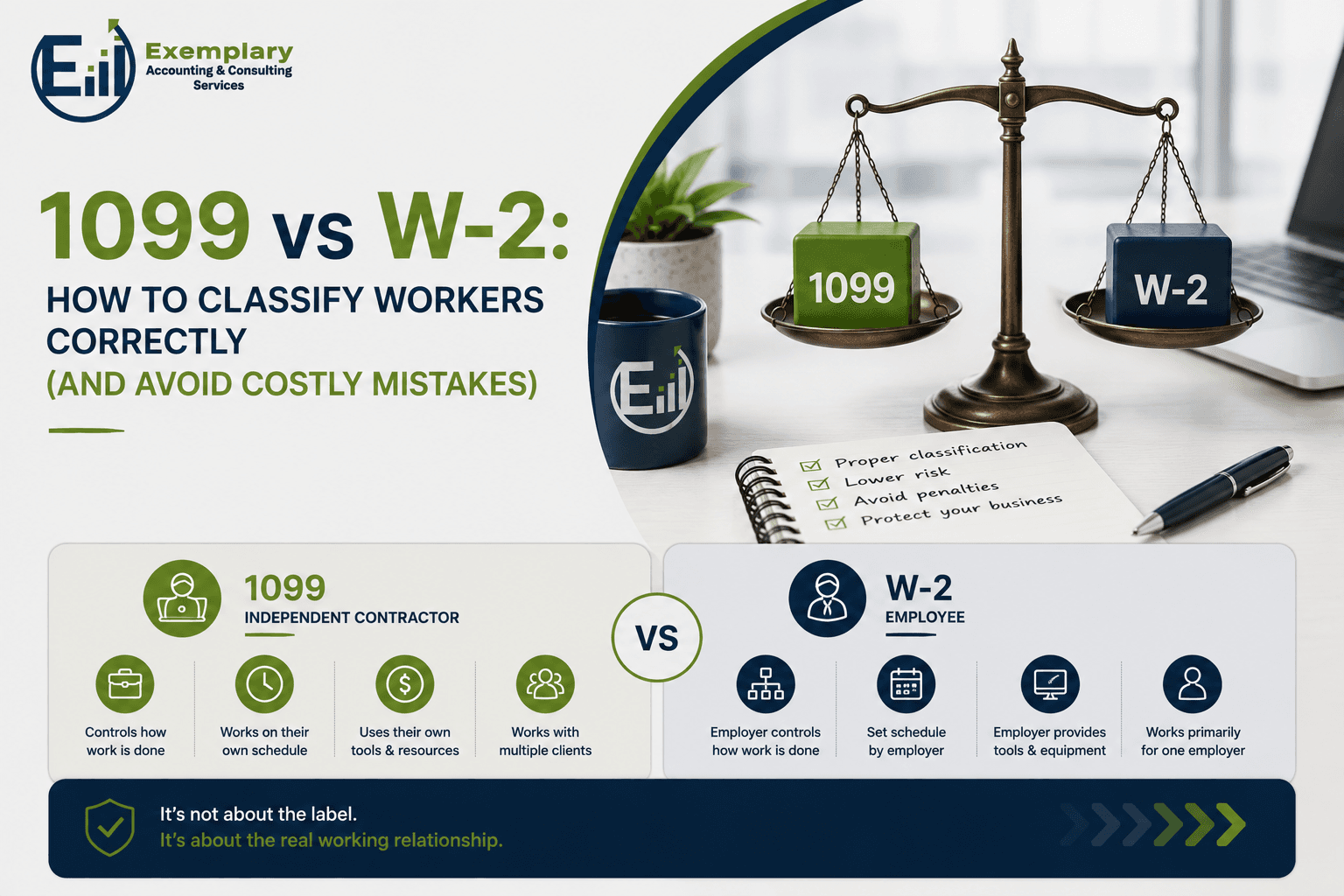
Calling someone a contractor does not make them one. Neither does having them sign an agreement that says so, or paying them through a 1099 instead of running payroll. Worker classification is decided by the actual working relationship, not by the label either side prefers.
Get it wrong and the cost shows up later, often much later, as back taxes, penalties, and interest covering every period the misclassification occurred.
Why the Distinction Exists
Employees and independent contractors are taxed completely differently. For an employee, you withhold income tax, withhold and match Social Security and Medicare, and typically provide certain protections. For a contractor, none of that applies. They handle their own taxes, including the full self-employment tax burden, and you simply issue a 1099 reporting what you paid them.
The financial difference is significant, which is exactly why misclassification, intentional or not, gets scrutinized closely.
How Classification Actually Gets Decided
There is no single factor that settles it. Classification is judged on the whole relationship, generally grouped into a few categories.
Behavioral control
Do you control how the work gets done, not just what the end result should be? Setting specific hours, requiring particular methods, or closely directing the day-to-day work all point toward employee status. A contractor decides their own process.
Financial control
Does the worker have a real opportunity for profit or loss, invest in their own equipment, and work for other clients? A worker financially dependent on one company, using that company's tools, paid a steady amount regardless of outcome, looks far more like an employee.
The nature of the relationship
Is the work ongoing and central to the business, or project-based and peripheral? A person doing the same core function as your employees, indefinitely, is a harder case to classify as a contractor no matter what the paperwork says.
No single answer from any one category is decisive. The classification comes from weighing the whole picture together.
Why Businesses Misclassify, Even With Good Intentions
Misclassification is rarely a deliberate scheme. It usually starts as a reasonable-sounding shortcut. Hiring a contractor is simpler than running payroll, so a role that was genuinely project-based at the start slowly becomes a full-time, ongoing function, and nobody revisits the classification as the relationship changed.
The label from month one often stops matching the reality by month twelve.
What Misclassification Actually Costs
If a worker is reclassified as an employee after the fact, the business can owe back payroll taxes for the entire misclassified period, along with penalties and interest. Multiply that across several workers or several years and the number gets large quickly. It is a far more expensive mistake to unwind than it would have been to classify correctly from the start.
Getting It Right From the Start
Document the actual working relationship honestly rather than the relationship that is most convenient on paper. Review classifications periodically rather than assuming the original label still applies, especially for long-running contractor relationships that have quietly evolved. When a role is genuinely ambiguous, treat that ambiguity as a signal to get a professional opinion rather than guessing in the direction that costs less today.
Cross-Border Hiring Adds Another Layer
If you hire contractors living abroad, classification questions get more complex still, involving not just US rules but the labor and tax laws of the contractor's own country. Hiring contractors abroad requires its own records and considerations well beyond a standard domestic 1099 relationship.
Classification Feeds Directly Into Your Books
However a worker is classified, it has to be recorded and paid consistently, which connects directly to your broader financial structure. Getting this right depends on clean financial separation and a properly built chart of accounts that reflects payroll and contractor costs distinctly. It also affects your own estimated tax obligations if you are the one being classified as a contractor rather than the one doing the hiring.
How Exemplary Helps
Exemplary helps business owners classify workers correctly from the start and reviews existing relationships that may have drifted out of the category they began in. Our consulting service works through ambiguous cases with you, and our bookkeeping service keeps payroll and contractor payments recorded correctly once the classification is settled.
The label on the payment is not what decides classification. The actual relationship is, and it is worth getting right before it becomes an expensive correction.
This article is general information, not tax or legal advice for your specific situation.